Luvinci
October 24, 2026
Shape Tracing Worksheets (Free Printable PDF)
3 free PDFs in this post
More PDFs (2)
Shape tracing worksheets give your child big shapes to follow with a crayon, starting each one at a green dot. Tracing shapes builds pencil control. It also ties each shape to its name. Kids trace curves first, then corners, then slants.
Parents and teachers of preschool and kindergarten children can use this guide.
Start at the green dot. Go round or down to the left. Stop back at the dot.
Our Shape Tracing Worksheets PDF is a free printable PDF with 12 pages. Kids trace and color shapes hidden in 4 picture scenes. After that they trace 8 big shapes and their names, then match, cut and build. You’ll find a shape chart and an answer key at the back. It’s free, with no signup and no email. The shape tracing mats and a roll-and-trace game each have their own free PDF, in the list at the top.
Jump to: the PDF · shapes in order · where to start · picture pages · preschool and K · play first · when it’s hard · FAQ
Free shape tracing worksheets (PDF)
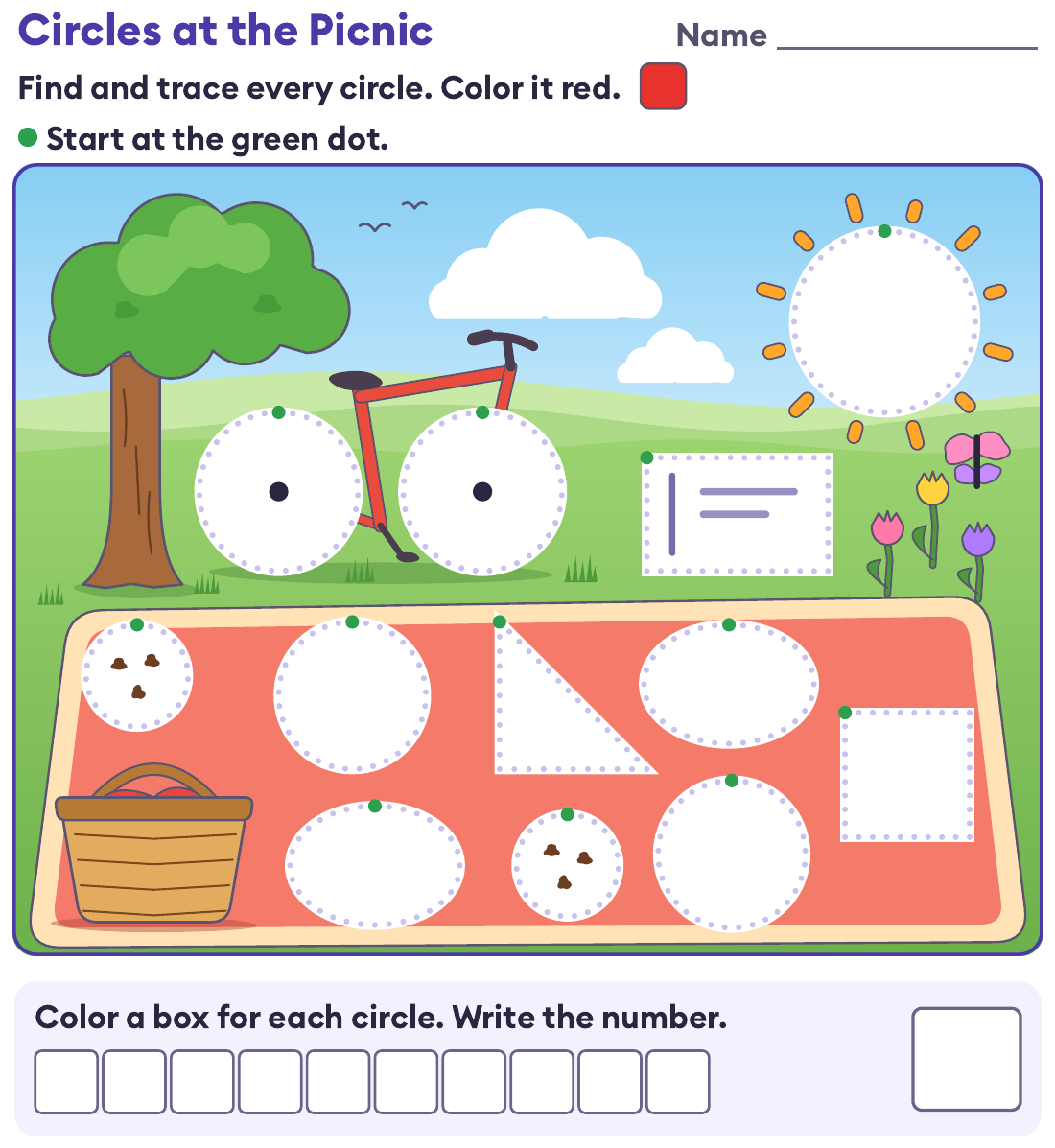
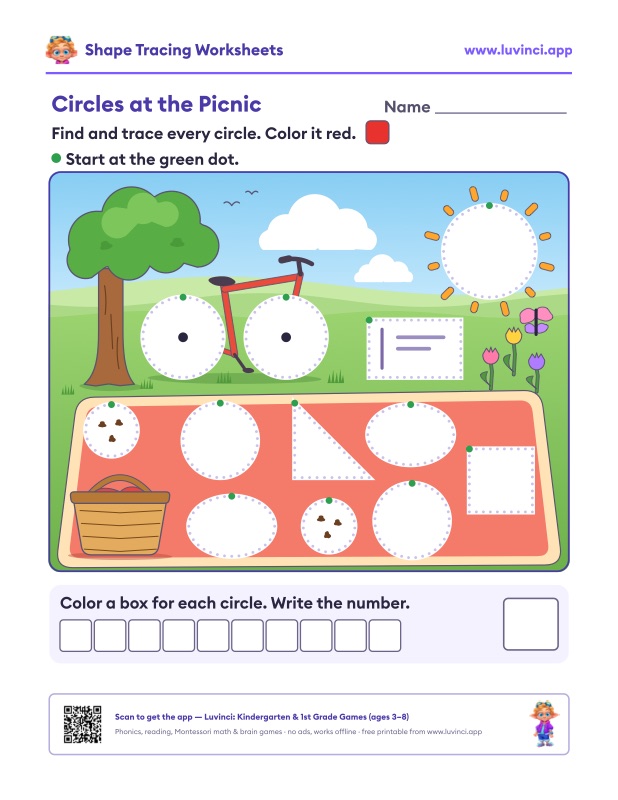
Page 1. Circles at the picnic.
This is what’s on each page of the Shape Tracing Worksheets PDF.
| Page | What’s on it |
|---|---|
| 1 | Circles at the Picnic. Trace and color the circles in a picnic scene, then color a box for each |
| 2 | Squares in the Kitchen. The same, with squares at snack time |
| 3 | Rectangles on Our Street. Doors, windows and a street sign |
| 4 | Triangles at the Lake. Tents, sails and little flags |
| 5 | Trace it, then draw it. Circle and oval |
| 6 | Trace it, then draw it. Square and rectangle |
| 7 | Trace it, then draw it. Triangle and hexagon |
| 8 | Trace it, then draw it. Heart and star |
| 9 | Trace and match. Trace 6 shapes and draw a line to the thing with the same shape |
| 10 | Trace, cut and build. Trace a house, a tree and a sun. Cut out the colored shapes and glue them on |
| 11 | Shape tracing chart. All 8 shapes with a start dot, arrows and a short saying |
| 12 | Answer key for the 4 picture pages and the match |
Pages 5 to 8 are classic tracing shapes worksheets. Every shape gets a big model with arrows, its name to trace, five copies and a box to draw one alone.
Printing tips:
- Slide pages 5 to 8 and 11 into a sheet protector and use a dry-erase marker. One printout lasts all year.
- Print a fresh copy of the color pages each time.
- Black and white is fine. The green dots print darker than the tracing dots.
- Print at 100% so the pieces on page 10 stay big enough to cut.
- Print page 11 on cardstock if you’d like to keep it as a chart.
Tracing shapes in order: circle first, star last
A few shapes come more easily than others. A circle is one smooth move. A square needs a stop at every corner. A triangle needs slants and corners together, so it comes last.
| Shape | Most children can copy it by about | Why here |
|---|---|---|
| Circle | 3 | The first closed shape |
| Oval | With the circle | The same move, just taller |
| Square | 4 and a half | The first corners |
| Rectangle | With the square | The same strokes |
| Triangle | 5 | Slants |
| Hexagon | No set age | On the kindergarten list, 6 corners |
| Heart | No set age | Curves into a point, a fun shape |
| Star | No set age | 10 corners, the hardest, so it comes last |
Those ages are for copying a shape alone. Tracing comes first, so a younger child can trace a shape sooner. Every child gets there at their own pace.
Circle, square and triangle are the shapes kids are asked to know before kindergarten. Hearts and stars aren’t on the kindergarten list. They’re still fun to trace.
A square turned on its corner looks like a diamond. It’s still a square, so it counts. A squished diamond has a math name, rhombus, that kids learn in 1st grade.
Where to start each shape
One green dot, one stroke, on every shape. Start at the top. Go round or down to the left first. Stop back at the dot.
One rule covers a shape that is turned. Start at the highest corner. If two corners are level, start at the left one. Then go round to the left. Circles and ovals start at the top in the middle. The heart starts at its dip.
| Shape | Start | Path | Say it while you trace |
|---|---|---|---|
| Circle | Top middle | Round to the left, back to the dot | “Start at the top, round we go, stop at the dot.” |
| Oval | Top middle | The same as the circle | “Like a circle, just taller.” |
| Square | Top-left corner | Down, across, up, across | “Down, across, up, across.” |
| Rectangle | Top-left corner | The same, with long sides and short sides | “Down, across, up, across.” |
| Triangle | Top point | Slide down to the left, across to the right, slide up | “Slide down, across, slide up.” |
| Hexagon (flat top) | Top-left corner | Down-left, down-right, across, up-right, up-left, across | “Count the sides, 1 to 6.” |
| Heart | The dip at the top | Up and round to the left, down to the point, up the right side, round to the dip | “Bump, point, bump.” |
| Star | Top point | Down and out to the left, round every point back to the top | “Count the points, 1 to 5.” |
| Turned shapes | Highest corner (the left one if two are level) | Round to the left | “Top corner first.” |
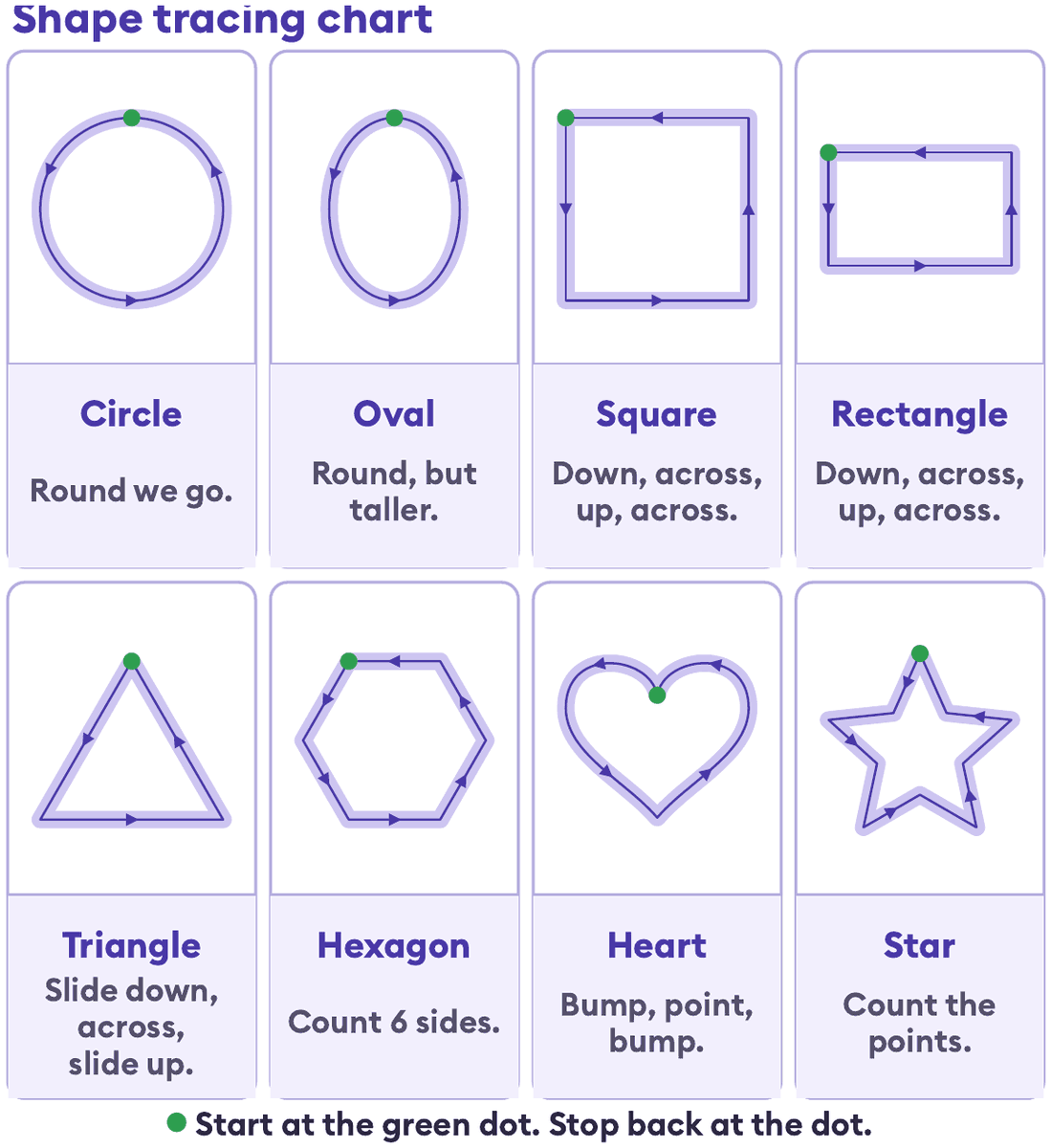
Page 11. Every shape’s start dot and path.
Some left-handed kids go round the other way, and for shapes that’s fine.
Find, trace and color: the picture pages
Every picture page hides one shape in a scene. Your child traces each dotted shape that matches, then colors it.
- Trace each matching shape from its green dot.
- Color it. Circles are red, squares orange, rectangles blue and triangles green. A swatch at the top shows the color.
- Color one box for each in the strip at the bottom, and write the number.
The other shapes in the picture are dotted too. Your child has to look first, then trace the shapes that match.
A few tricky ones:
- An egg is an oval, not a circle.
- A turned square is still a square, and it counts. One cracker in the kitchen sits on its corner.
- Upside-down and skinny triangles count too. The little flags at the lake point down.
- The rectangle page has no squares. A square is a special rectangle, so we left squares off to keep the count fair.
You’ll find the answers in the key on page 12. Don’t tell the number. Let your child count the boxes they colored.
Shape tracing worksheets for preschool and kindergarten
Preschool. Trace with a finger first, then a chunky crayon. Use only the big model and the biggest copy on pages 5 to 8. Start with the circle and the square. One shape a day is plenty. Skip the names for now.
Kindergarten. Trace all 8 shapes, and trace each name too. Fill the “Draw one” box every time. Drawing it alone is how it sticks. Then try the cut and build page. The kindergarten list is circle, square, triangle, rectangle and hexagon. Pages 5 to 10 make good kindergarten tracing shapes worksheets. They add drawing, matching and building.
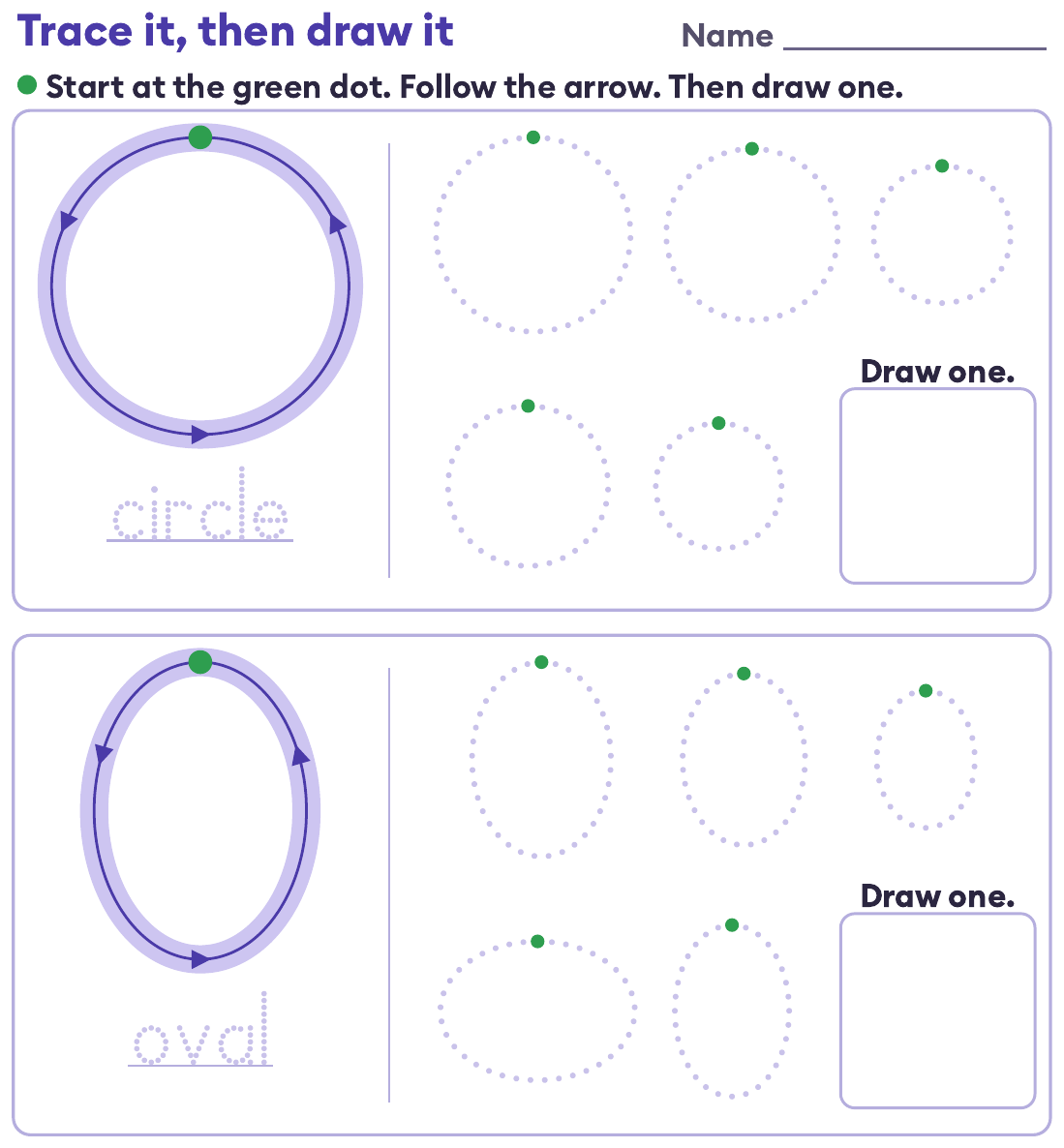
Page 5. Trace it, then draw it.
Before the page: big moves and play
Play comes first, then the page. Big moves teach the path before the crayon has to follow it.
- Air shapes. Trace a giant shape in the air with a straight arm.
- Sand or salt tray. Draw a shape with a finger. Shake to erase.
- Go big. Use a whiteboard, or paper taped to the wall.
- Playdough snakes. Roll a snake and lay it on a shape.
- Bendy shapes. Bend wax craft sticks or pipe cleaners into shapes.
- Back drawing. Draw a shape on your child’s back and let them guess it.
- Rubbings. Cut shapes from card and rub a crayon over them under paper.
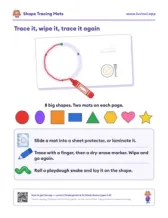
Our free Shape Tracing Mats are 8 big shapes, two to a page. Slide one into a sheet protector or laminate it. Trace with a finger, then a dry-erase marker, or lay a playdough snake on the shape.
Roll and trace: a shape tracing game
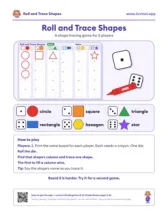
In our free Roll and Trace Shapes game, a die picks the shape.
- Players: 2. Print the same board for each player. Each needs a crayon. One die.
- Roll the die.
- Find that shape’s column and trace one shape.
- The first to fill a column wins.
- Tip: Say the shape’s name as you trace it.
1 is a circle, 2 a square, 3 a triangle, 4 a rectangle, 5 a hexagon and 6 a star. Board 2 has turned shapes for a harder second game.
When a circle won’t close
Say “Around and stop!” out loud as your child traces. The green dot is the stop sign too.
- Go bigger. Try the whiteboard or the air.
- Feel it first. Run a finger round the rim of a paper plate.
- Follow the road. On pages 5 to 8, trace the wide pale road around each big model before the dots.
- Hand over hand. Guide your child’s hand for a turn or two, then let go.
- Make it a thing. Turn the circle into a sun with a face.
Corners that come out round need a pause. Say “down, stop, across, stop.” Tap each corner before your child turns. Count the corners out loud.
A gap, a wobble or a little overshoot is normal at 3 and 4. Every child gets there at their own pace. If drawing shapes stays very hard, or your child stays away from crayons, talk to your child’s teacher.
Many children settle into a three-finger grip between about 4 and 6. A different grip that still works is fine. Short or broken crayons help a small hand. Our fine motor skills guide has games for hand strength.
Shapes and letters use the same moves
The circle’s move, round to the left, is how c, o, a, d and g begin. The square’s down and across is L, E, F and H. The triangle’s slants are A, V and W. Those same moves show up in letters.
Our letter tracing worksheets and number tracing worksheets use the same green dots and arrows.
FAQ
Which shapes should kids trace first?
Circle first, then square, then triangle. Those three are the first shapes most kids learn, and the shapes for kindergarten guide has the full list.
What are the benefits of tracing shapes?
Tracing shapes builds pencil control. Kids learn to stop at corners, turn on curves and close a shape. Each shape also gets tied to its name.
What are some fun tracing activities for kids?
Start with big moves, like air shapes, a sand tray or a whiteboard. Lay playdough snakes on a mat. Play the roll-and-trace game, or trace a picture and color it after.
What shapes can a 3 year old trace?
Big circles first, with a finger and then a chunky crayon. Squares and simple triangles come next. Hearts and stars are fun extras.
At what age should kids start tracing shapes?
Finger tracing big shapes often starts around 2 or 3. Most children can copy a circle around 3, a square around 4 and a half and a triangle around 5. Tracing comes earlier, so a younger child can trace them first.
Should kids learn shapes before letters?
Shapes and letters use the same moves, so shapes make a gentle warm-up. Plenty of kids do both at once. There’s no need to wait.
Are these shape tracing worksheets free?
Yes. You can use them free at home and in the classroom, with no signup and no email. Answer keys for the picture pages and the match are on page 12.
The takeaways
- Start at the green dot. Stop back at the dot.
- Curves first, then corners, then slants.
- Big moves and play before the page.
- Look first, then trace. The shapes that don’t match are dotted too.
- Turned, skinny or upside down, it’s the same shape.
- Trace it, then draw it alone.
- A few minutes a day is enough.
- Print the free Shape Tracing Worksheets PDF: 12 pages with an answer key, no signup.
Try the free counting board in the Luvinci app. The ten-frame, addition, subtraction and times-table boards are in the full app. See how Luvinci’s math games work.
More free math pages, each with its own free PDF:
- Shapes for kindergarten: 2D and 3D shapes
- Number tracing worksheets 1-20
- Counting mats and number sense activities
- More shape pages in the math printables library
Sources
- AOTA Children and Youth Special Interest Section. Pre-Writing and Handwriting Skills infographic (2025).
- Solihull Children’s Occupational Therapy Service, University Hospitals Birmingham NHS FT. Pre-writing skills (2024).
- Fife Health and Social Care Partnership, Children and Young People’s Occupational Therapy (NHS Fife). Top tips for developing pre-writing skills (May 2020).
- Common Core State Standards for Mathematics. Kindergarten Geometry (K.G.2, K.G.5).
- Common Core State Standards for Mathematics. Kindergarten introduction.
More free math worksheets: ten frames, number charts, addition and subtraction, daily practice workbooks and more, all in one place. See the math printables →